President Jokowi’s declaration of two positive covid 19 cases in Indonesia early March 2020 has shaken all the citizens, sounding the alarm that the disease originally identified in Wuhan, China is indeed around.
Not only urban communities but rural communities are also increasingly worried. Not only will Covid 19 adversely affect their health, their economy will also be disrupted. They cannot imagine if their villages have to be quarrantined and eventually shut down. They will definitely be unable to carry out their agricultural practice, in this case oil palm production. Palm oil companies will shut down; traditional markets will be closed. Unrest will be very likely, leading to social frictions.
As a form of Covid 19 prevention and of participation in supporting government’s call for solidarity, a number of FORTASBI’s RSPO-certified cooperative or group members have taken some local actions to combat Covid 19.
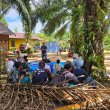
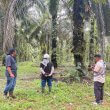
Gapoktan Boluk Bersatu (an association of farmer groups), which recently obtained RSPO certificate, initiated mass disinfections at strategic locations and houses. In addition, this Sei Mangke-based group distributed free masks for the village community. In South Sumatra, KUD Teratai Biru (a cooperative) also disinfected the village it is based in – Peninggalan – as it is situated along the East Highway (Jalan Lintas Timur).
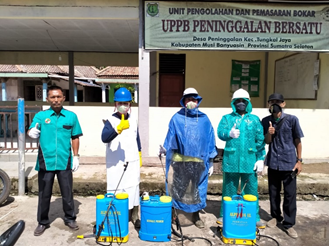
An association called Asosiasi Swadaya Amanah, which operates in Ukui Riau and which was the first group to obtain RSPO and ISPO certificates, also sprayed disinfectants at public places such as mosques, schools and gathering places. In Central Kalimantan Koperasi Sawit Bangkit, which was assisted by Inobu to obtain RSPO and ISPO certificates, also sprayed disinfectants at the village.
Besides conducting mass disinfections and distributiing free masks, all these groups also campaigned for clean lifestyle. In Boluk Bersatu, the campaign for clean lifestyle and hand-washing is supported by Unilever.
It takes many hands together to prevent further spread of Covid 19 as we are all interdependent. The virus does not recognize state borders, let alone provincial boundaries. Globally, up to 203 countries have been infected so far.